
Sunday, March 30, 2008

Monday, March 24, 2008
Taking It Back
A.D. 427
Seventy-two years have I lived now. Praise be to you, My Life, for every one of them. And here I sit with my many books before me. What are they to you, O Lord? I have written them for you, and now I give them to you once more, one last time. If you give me days enough, before my body fails me, before the Vandals come and burn them, I will read them once again and I will measure them against the rule of faith and the Truth which You are, as you give me strength and wisdom so to do.
In these books is my best, O Lord: My sharp swords against the heresies of the Donatists and against Pelagius, who blasphemed your grace. And my City of God, by which I made apologia for those who blamed you for the demise of all the greatness of Rome. And my sweet Confessions, by which I sought to honor you for how you sought and found me. And all the teachings and sermons and letters I have penned in your service. Through the fire of your perfect law will these be refined, and now I hold them up and pray You: May the words of my mouth and meditations of my heart be acceptable in Your sight, O Lord, my Rock and my Redeemer.

So I will take it back, what I have said, if I have said it against the truth. And I will hope that I may lead none astray. Such as I have give I Thee, O my Perfect God and Savior of my Soul.
Seventy-two years have I lived now. Praise be to you, My Life, for every one of them. And here I sit with my many books before me. What are they to you, O Lord? I have written them for you, and now I give them to you once more, one last time. If you give me days enough, before my body fails me, before the Vandals come and burn them, I will read them once again and I will measure them against the rule of faith and the Truth which You are, as you give me strength and wisdom so to do.
In these books is my best, O Lord: My sharp swords against the heresies of the Donatists and against Pelagius, who blasphemed your grace. And my City of God, by which I made apologia for those who blamed you for the demise of all the greatness of Rome. And my sweet Confessions, by which I sought to honor you for how you sought and found me. And all the teachings and sermons and letters I have penned in your service. Through the fire of your perfect law will these be refined, and now I hold them up and pray You: May the words of my mouth and meditations of my heart be acceptable in Your sight, O Lord, my Rock and my Redeemer.
So I will take it back, what I have said, if I have said it against the truth. And I will hope that I may lead none astray. Such as I have give I Thee, O my Perfect God and Savior of my Soul.
On Moralistic Therapeutic Deism

I’ve been asked to comment on a certain religious phenomenon called Moralistic Therapeutic Deism.
That religion would be interested in therapy makes all the sense in the world to me. Therapy comes from the Greek word therapeuein, which means “to heal.” Where should we turn for healing if not the Great Physician of our Souls? Teach us, Lord Christ, to pray to you even as the centurion whom you commended for his faith: “Speak the word, Lord, and my servant shall be healed.” “He was wounded for our transgressions, He was bruised for our iniquities; the chastisement for our peace was upon Him, and by His stripes we are healed” (Isaiah 53:5). It is our sinful folly that leads us to seek healing in material things and not in your healing word and the therapy of your Spirit, O Lord.
But this I do not understand: This MTD speaks of healing as if it were the same as feeling good about oneself. I have heard young devotees praise God with these selfish words: “It made me feel better.” So it would seem that the passions are the measure of all things. This is, of course, a great error and a confusion, for it is as though the physician were to begin at the outside, with the symptoms of the sickness, but ignore completely the source and cause of the malady. For the source of our sickness of soul is in our will, corrupted by our original sin, in which we all willingly conspire against our better judgment. Ours is a great sickness of soul which springs from our two wills—from our divided will. Neither will is whole, for what our right minds will to be and do, our wills do not wholly will; and what we know to be wrong, this we choose, though with much regret and sadness.
The only true healing comes to us through the Righteous One, who took on our nature so that we might partake of his divine nature and become whole again. God made him who had no sin to be sin for us, that in him we might become the righteousness of God.
This MTD of which modern people speak is also misguided because it seeks happiness in the wrong place. All men seek happiness, as our Lord well knew when he spoke to his disciples and told them what sort of life would bring happiness (the Beautitudes in Mt. 5). Only the man who finds his greatest good is the happy man. And what is the greatest good of man? Surely it cannot be anything inferior to man himself. And it cannot be the good of the body only, for the body is surpassed in greatness by the soul. The chief end of the soul is to behold the beauty of God Himself and to love the Lord God with all one’s soul. He who has this lacks nothing; and he who lacks this, no matter what other goods he has, cannot be truly happy. MTD promises what no one can deliver: Happiness apart from the crucifixion of the self and union with the divine nature. The perfection of all our good things and our perfect good is God. Happy is the man who knows this and lives by it.
My Reflections on Psalm 1

Blessed is the man who does not walk in the counsel of the ungodly,
Or stand in the way of sinners,
Or sit in the seat of pestilence;
But his delight is in the law of the Lord,
And on his law he meditates day and night.
He shall be like a tree planted by streams of living water.
Who is this “man” the Psalmist talks about? It is the Lord Jesus Christ, the Lord Man. He it is who has entered the world and faced all its enticements and yet not succumbed to their evil. He is the second Adam. The First Adam was a man of the earth (1 Cor. 15:47), who went the way of the ungodly; but the Second Adam chose instead the law of God. The First Adam was the first in a long, long line of sinners; but our Second Adam was born in the way of sinners and yet did not succumb to the enticements of sin. The First Adam sat in the seat of pestilence, which spread to all—and the disease that spread was false doctrine, the lies of Satan, which “spread like a canker,” as the apostle says (2 Timothy 2:17); but the Second Adam is the only One who has not been trapped by this great line of sin. He alone can set us free from the dominion of sin and heal this deadly pestilence.
The Lord Jesus Christ is the one who delights in the law of the Lord. He is in the law, but not under it. Those under the law are slaves to the law, but the one who is in the law does not need the letter of the law, but obeys its true purpose. He meditates on it by day—which means in the good times—and by night—which means in the hard times.
And this Lord Christ is that Very Wisdom of which the Scriptures speak (Proverbs 8), who assumed our nature. He is the tree which brings forth life, like a spring of living water—the one who stood and said on the last and greatest day of the feast, “If anyone is thirsty, let him come to me and drink. Whoever believes in me, as the Scripture has said, streams of living water will flow from within him” (John 7:37). And those who live in him will bring forth fruit. By the sending of the Holy Ghost to the Apostles, and by the confirming of their faith in Him, and their mission to the world, He made the Churches to “bring forth fruit.” “His leaf also shall not fall,” that is, His Word shall not be in vain. For, “all flesh is grass, and the glory of man as the flower of grass; the grass withers, and the flower fades, but the word of the Lord abides for ever (Is. 40).
And whatever he does, he shall prosper” that is, whatever that tree shall bear; which all must be taken of fruit and leaves—both words and deeds.
Or stand in the way of sinners,
Or sit in the seat of pestilence;
But his delight is in the law of the Lord,
And on his law he meditates day and night.
He shall be like a tree planted by streams of living water.
Who is this “man” the Psalmist talks about? It is the Lord Jesus Christ, the Lord Man. He it is who has entered the world and faced all its enticements and yet not succumbed to their evil. He is the second Adam. The First Adam was a man of the earth (1 Cor. 15:47), who went the way of the ungodly; but the Second Adam chose instead the law of God. The First Adam was the first in a long, long line of sinners; but our Second Adam was born in the way of sinners and yet did not succumb to the enticements of sin. The First Adam sat in the seat of pestilence, which spread to all—and the disease that spread was false doctrine, the lies of Satan, which “spread like a canker,” as the apostle says (2 Timothy 2:17); but the Second Adam is the only One who has not been trapped by this great line of sin. He alone can set us free from the dominion of sin and heal this deadly pestilence.
The Lord Jesus Christ is the one who delights in the law of the Lord. He is in the law, but not under it. Those under the law are slaves to the law, but the one who is in the law does not need the letter of the law, but obeys its true purpose. He meditates on it by day—which means in the good times—and by night—which means in the hard times.
And this Lord Christ is that Very Wisdom of which the Scriptures speak (Proverbs 8), who assumed our nature. He is the tree which brings forth life, like a spring of living water—the one who stood and said on the last and greatest day of the feast, “If anyone is thirsty, let him come to me and drink. Whoever believes in me, as the Scripture has said, streams of living water will flow from within him” (John 7:37). And those who live in him will bring forth fruit. By the sending of the Holy Ghost to the Apostles, and by the confirming of their faith in Him, and their mission to the world, He made the Churches to “bring forth fruit.” “His leaf also shall not fall,” that is, His Word shall not be in vain. For, “all flesh is grass, and the glory of man as the flower of grass; the grass withers, and the flower fades, but the word of the Lord abides for ever (Is. 40).
And whatever he does, he shall prosper” that is, whatever that tree shall bear; which all must be taken of fruit and leaves—both words and deeds.
Sunday, March 23, 2008
Made in Milan
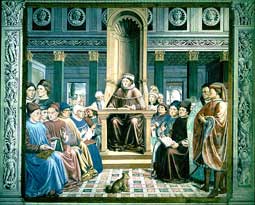
Fall, A.D. 384
Met a great man named Symmachus, prefect of Rome, just this fall. Some Manichaean friends introduced us. My lucky break, because he needed to find someone to fill the chair of Rhetoric for the Emperor's court in Milan. So I'm on my way to what is arguably the most prestigious academic chair in the Latin world.
I should be very happy--and I am. But something still nags at me. I hope Milan is everything I want it to be, I hope it sets me on the track to happiness. I hope it doesn't disappoint like Rome did. Rome was supposed to be the greatest place on the face of the earth. For a country boy from North Africa, I imagined Roman youths would be the best and brightest. But I found my students dull and unmotivated, and when it was time for them to pay their fees, they went on vacation.
And Rome is not the only gold that does not glitter. I'm losing my faith in the great Manichaean religion too. I know that many rich and famous hold to the teachings of Mani, and I have too. But I met a famous Manichaean in Carthage, before I sailed for Rome, and I talked with him for hours. He was very disappointing. Is this the best they can do?
In Rome I have met many sceptics, members of the New Academy. They are bright enough, but they too disappoint. I wonder if every philosophy lets us down in the end? I wonder if there are any leaders who impress more once you get to know them? My mother and others want me to meet a certain Ambrose in Milan--a teacher of rhetoric and a Christian. He'll probably let me down like the rest of these famous philosophers.
My Pear Tree Story

A.D. 370
I've been home from school this year. My parents have been a little tight on money, and I had to come home. I've had more time on my hands than was good for me, I suppose. I spend a lot of time at the baths, maybe too much time. Mother hates that, but father is proud of me, I can tell, proud that I am becoming a man.
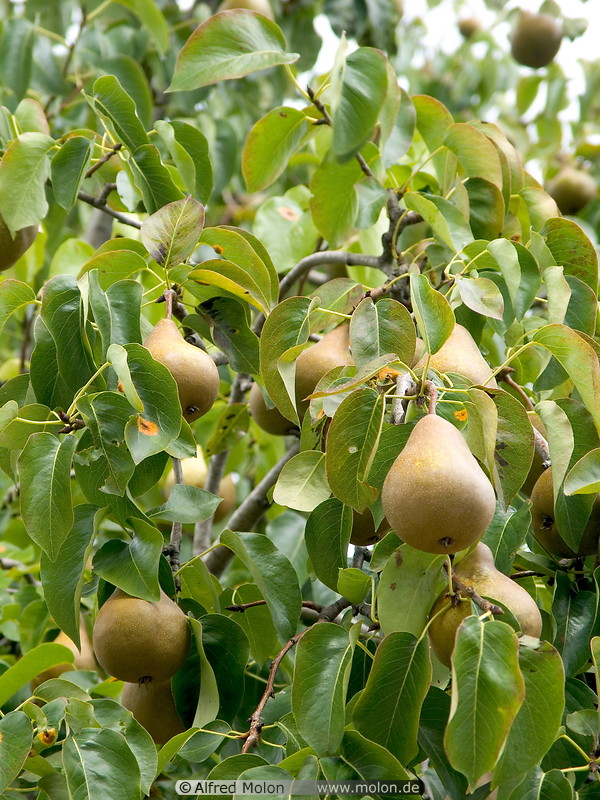
Last night we left the baths and hung out in the streets of Thagaste until it was very late--playing our inane games and making noise and trouble, cat-calling to the young girls who dared to walk the streets with us abroad. Then, when that fun was all spent and no fun anymore, we had the idea of stealing pears from a nearby orchard. It was near our family vineyard, and we climbed the fence and loaded our togas with pears. Dozens of them.
Funny thing is that we took so many of them but they weren't even that good. They didn't look particularly good--they were spotty and small. And they surely didn't taste good--I think I had one bite. And none of us needed pears. We have a bowlful of better pears sitting on the table at home, and all of my friends come from wealthy homes. We ended up throwing all the pears to the hogs!
I have to say, though, that I loved it. I loved the danger of it. I loved the company of my fellow thieves. But most of all, I loved the theft itself. Just the sin of it. If I weren't afraid of mother finding out and disappointing her, I might do it again.
I've been home from school this year. My parents have been a little tight on money, and I had to come home. I've had more time on my hands than was good for me, I suppose. I spend a lot of time at the baths, maybe too much time. Mother hates that, but father is proud of me, I can tell, proud that I am becoming a man.
Last night we left the baths and hung out in the streets of Thagaste until it was very late--playing our inane games and making noise and trouble, cat-calling to the young girls who dared to walk the streets with us abroad. Then, when that fun was all spent and no fun anymore, we had the idea of stealing pears from a nearby orchard. It was near our family vineyard, and we climbed the fence and loaded our togas with pears. Dozens of them.
Funny thing is that we took so many of them but they weren't even that good. They didn't look particularly good--they were spotty and small. And they surely didn't taste good--I think I had one bite. And none of us needed pears. We have a bowlful of better pears sitting on the table at home, and all of my friends come from wealthy homes. We ended up throwing all the pears to the hogs!
I have to say, though, that I loved it. I loved the danger of it. I loved the company of my fellow thieves. But most of all, I loved the theft itself. Just the sin of it. If I weren't afraid of mother finding out and disappointing her, I might do it again.
Subscribe to:
Posts (Atom)